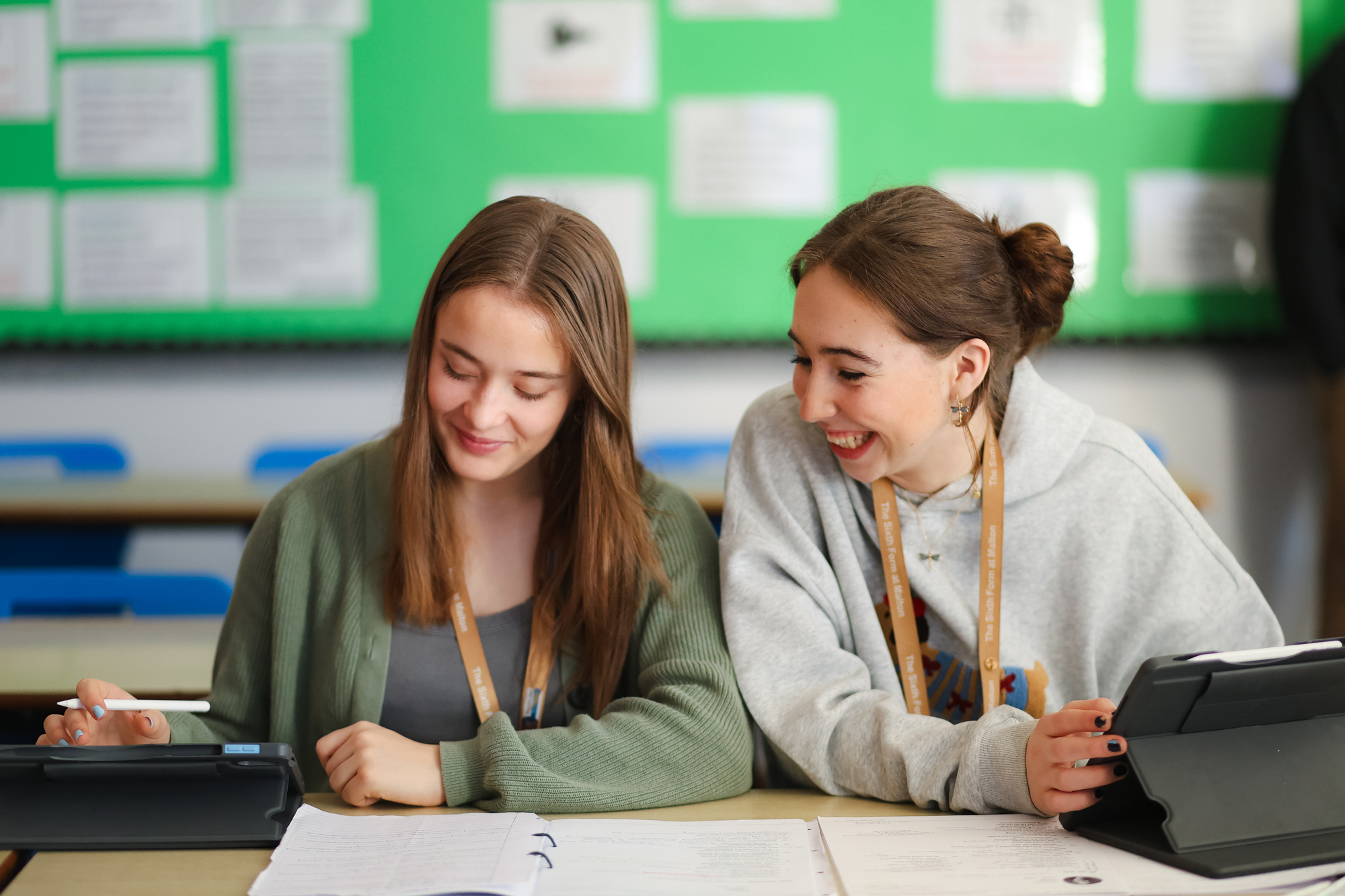
Compared with the GCSE course, you will find that a much greater part of lesson time is taken up with discussion of new ideas and techniques, leaving much of your own written practice to be completed independently. As the course progresses, an increasing emphasis is placed on developing your ability to present a reasoned solution to a problem, rather than on simply obtaining an "answer". A-Level Maths is delivered in a ‘paperless’ way with all resources shared and worked on in OneNote, this means no exercise books, textbooks or folders. Pure Mathematics Pure Maths develops the algebraic techniques of simplification and equation solving well beyond the level of GCSE. The two branches of calculus are introduced: "differentiation" deals with the way in which continuously varying quantities change, and "integration" studies the cumulative effect of a continuous variable. Other topics include: the study of geometry, algebraic and trigonometric functions, and the introduction of logarithmic and exponential functions. Mechanics Mechanics is the study of forces and motion. It explores the properties of position, velocity, acceleration, force, momentum, energy, and the relationships between the forces acting on a stationary object. Statistics Statistics is concerned with the collection, organisation, representation, analysis, and interpretation of data. Topics covered are: descriptive statistics, probability, random variables, linear regression, sampling and hypothesis testing.
GCSE Maths at Level 6 and an average points score of 6.0+
The course is assessed through 3 x 2 hour exams at the end of year 13. All 3 exams are calculator based with Paper 1 being 100 marks of Pure Maths, Paper 2 being 100 mark split between Pure Maths and Mechanics and then Paper 3 being 100 marks split between Pure Maths and Statistics. The exam board used is AQA.
About Education Provider
| Region | Yorkshire and the Humber |
| Local Authority | North Yorkshire |
| Ofsted Rating | |
| Gender Type | Co-Educational |
| Address | Middlecave Road, Malton, YO17 7NH |
Compared with the GCSE course, you will find that a much greater part of lesson time is taken up with discussion of new ideas and techniques, leaving much of your own written practice to be completed independently. As the course progresses, an increasing emphasis is placed on developing your ability to present a reasoned solution to a problem, rather than on simply obtaining an "answer". A-Level Maths is delivered in a ‘paperless’ way with all resources shared and worked on in OneNote, this means no exercise books, textbooks or folders. Pure Mathematics Pure Maths develops the algebraic techniques of simplification and equation solving well beyond the level of GCSE. The two branches of calculus are introduced: "differentiation" deals with the way in which continuously varying quantities change, and "integration" studies the cumulative effect of a continuous variable. Other topics include: the study of geometry, algebraic and trigonometric functions, and the introduction of logarithmic and exponential functions. Mechanics Mechanics is the study of forces and motion. It explores the properties of position, velocity, acceleration, force, momentum, energy, and the relationships between the forces acting on a stationary object. Statistics Statistics is concerned with the collection, organisation, representation, analysis, and interpretation of data. Topics covered are: descriptive statistics, probability, random variables, linear regression, sampling and hypothesis testing.
GCSE Maths at Level 6 and an average points score of 6.0+
The course is assessed through 3 x 2 hour exams at the end of year 13. All 3 exams are calculator based with Paper 1 being 100 marks of Pure Maths, Paper 2 being 100 mark split between Pure Maths and Mechanics and then Paper 3 being 100 marks split between Pure Maths and Statistics. The exam board used is AQA.